Safety doesn’t start with policy documents buried in a folder. It starts in the huddle before the shift begins—on the site, in the yard, or in the workshop. This is where toolbox talks matter. In the UK, where HSE regulations are stringent and workplace safety is non-negotiable, using structured toolbox talk templates UK professionals rely on is the difference between going through the motions and driving real behavioural change.
Yet many supervisors still wing it—scribbling talking points on a notepad or recycling vague, outdated scripts. The result? Disengaged teams, inconsistent messaging, and compliance gaps that only show up after an incident.
The solution isn’t reinventing the wheel. It’s using well-structured, HSE-aligned toolbox talk templates UK teams can adapt quickly, deliver confidently, and document properly.
Why UK Workplaces Need Standardised Toolbox Talk Templates
Toolbox talks are short, focused safety discussions—usually 10 to 15 minutes—held at the start of a shift or before a high-risk task. They’re designed to reinforce safe practices, address emerging hazards, and encourage team dialogue. In the UK, they're not legally mandatory, but they are a recognised best practice under the Health and Safety at Work Act 1974 and Management of Health and Safety at Work Regulations 1999.
Without templates, however, these talks become inconsistent. One supervisor might cover PPE thoroughly; another might skip it entirely. One site may document every session; another logs nothing. This inconsistency increases liability.
Toolbox talk templates UK offer a framework that ensures: - Core safety topics are covered uniformly - Legal and site-specific risks are addressed - Discussions remain relevant and concise - Attendance and engagement are recorded - Audit trails support HSE compliance
Templates aren’t about rigidity—they're about reliability. They turn ad-hoc conversations into repeatable, measurable safety moments.
What Makes a High-Quality Toolbox Talk Template in the UK?
Not all templates are created equal. A strong UK toolbox talk template should do more than list bullet points. It should guide the facilitator, engage the team, and support compliance.
Key features of an effective template:
1. Clear Topic Focus Each template should target one specific hazard—e.g., working at height, manual handling, or COSHH exposure. Avoid broad themes like “general safety.”
2. HSE & Industry Alignment UK-specific regulations matter. Templates should reference the HSE, CDM 2015, PUWER, or other applicable standards where relevant.
3. Facilitator Guidance Include prompts like “Ask the team: Have you seen this hazard before?” or “Demonstrate correct lifting posture.” This prevents the talk from becoming a lecture.
4. Risk Assessment Link The best templates reference or integrate with existing risk assessments and method statements (RAMS), ensuring continuity.
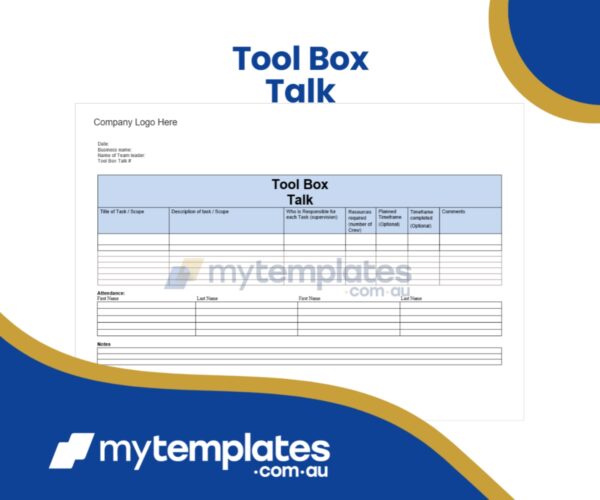
5. Sign-Off & Record Section Include fields for: - Date and location - Supervisor name - Attendee signatures - Action items or follow-ups

6. Visual & Language Clarity Use plain English. Avoid jargon. Where possible, include icons, diagrams, or photos—especially helpful for diverse or multilingual teams.
Common Mistakes in Using Toolbox Talk Templates
Even with good templates, poor delivery undermines their value. Here’s what to avoid:
- One-size-fits-all repetition
- Reusing the same "slips and trips" talk every week breeds disengagement. Tailor content to current site conditions.
- Reading verbatim
- Templates are guides—not scripts. Encourage natural dialogue. Use open-ended questions.
- Ignoring feedback
- If workers raise concerns during the talk, log them. Follow up. Otherwise, they’ll stop speaking up.
- Poor timing
- Don’t hold talks when people are rushing, distracted, or already on task. Early in the shift is ideal.
- No follow-up documentation
- A talk without a record is as good as never having happened. Store signed sheets digitally or in site logs.
5 Free & Trusted Toolbox Talk Templates UK Sites
You don’t need to write every template from scratch. Several reputable UK-based providers offer free, downloadable toolbox talk templates UK teams can use immediately:
| Resource | Speciality | Format | Customisable? | Notes |
|---|---|---|---|---|
| HSE Website | Government-backed, legally sound | PDF/Word | Yes | Basic but compliant. Ideal for low-risk environments. |
| CITB | Construction-specific | Partial | Aligned with Site Safety Plus. Best for CSCS-trained teams. | |
| SafetyCloud | Digital safety platform | Editable templates | Yes | Cloud-based with signing and tracking. Free samples available. |
| MakeItSafe | SME-focused | Word/PDF | Yes | User-friendly, includes visual aids. UK-written. |
| BHSL (British Health & Safety Ltd) | Industry-wide topics | Limited | High production value. Some free; full access requires subscription. |
Pro Tip: Download 2–3 templates on the same topic (e.g., electricity safety), compare their structure, and blend the best elements into your own master version.
How to Adapt Templates for Real-World Use
A template is only as good as its application. Here’s how to make them work on the ground:
#### Step 1: Audit Your Site Risks Run through your latest risk assessments. Identify 6–12 recurring hazards. These become your annual toolbox talk calendar.
#### Step 2: Localise the Content Modify templates to reflect: - Your site layout - Equipment in use - Recent incidents or near misses - Weather conditions (e.g., winter safety)
Example: A generic "working at height" template should include references to your scaffolding type, edge protection status, and harness inspection process.
#### Step 3: Assign & Rotate Facilitators Don’t let the site manager deliver every talk. Train supervisors to lead. Rotate presenters to build ownership.
#### Step 4: Add a “Lessons Learned” Section After a near miss or inspection, create a one-off talk. Use the template format to document what happened, why, and how to prevent recurrence.
#### Step 5: Store & Review Keep completed templates for at least 5 years. During audits or incident investigations, they prove due diligence.
Industry-Specific Template Examples

Different sectors face different risks. Here’s how toolbox talk templates UK vary across industries:
Construction Topics: Scaffolding safety, crane operations, excavation Template focus: Visuals, PPE checks, permit-to-work links Used daily on site. Often part of SMSTS/SSSTS compliance.
Utilities & Engineering Topics: Confined space entry, electrical isolation, lockout-tagout Template focus: Step-by-step control measures, verification High compliance due to regulatory scrutiny (EAWR 1989, etc.).
Warehousing & Logistics Topics: Forklift safety, load stability, pedestrian routes Template focus: Site maps, traffic flow diagrams Used weekly with shift teams.
Manufacturing Topics: Machine guarding, hot work, noise exposure Template focus: Equipment-specific checks, maintenance logs Integrated with PUWER inspections.
Making Toolbox Talks Engaging, Not Obligatory
The biggest threat to safety culture isn’t ignorance—it’s complacency. When talks become routine, attention fades.
Ways to boost engagement:
- Start with a story
- “Last week, a worker in Birmingham lost a glove to a conveyor. Here’s how we avoid that.”
- Use props
- Bring a damaged harness, a cracked helmet, or a faulty plug. Show, don’t just tell.
- Ask for input
- “What’s one hazard you’ve noticed this week?” Record answers. Act on them.
- Rotate locations
- Hold talks at the hazard—e.g., by the ladder, near the generator.
- Time it right
- Keep it under 12 minutes. Respect workers’ time.
Templates should support this interaction, not stifle it. The best ones have space for handwritten notes and team comments.
Finalise, Deliver, Document
A toolbox talk template UK is only the beginning. The real value comes from consistent delivery, team involvement, and proper follow-up.
Don’t treat these talks as box-ticking exercises. Use them to: - Reinforce accountability - Surface hidden risks - Build a culture where safety is spoken, not just posted
Start by selecting 3 core templates from trusted UK sources. Customize them. Train your supervisors. And review your logs monthly.
When done right, toolbox talks don’t just comply with HSE expectations—they prevent incidents before they happen.
FAQ
What is a toolbox talk template? A structured guide for delivering short, focused safety discussions on site, covering hazards, controls, and team engagement.
Are toolbox talks a legal requirement in the UK? Not legally mandatory, but strongly recommended by the HSE and considered best practice under health and safety law.
Where can I download free UK toolbox talk templates? Reliable sources include the HSE website, CITB, SafetyCloud, and MakeItSafe—all offer free, downloadable templates.
How often should toolbox talks be held? Ideally weekly or before high-risk tasks. Frequency depends on site activity, risk level, and project phase.
Should toolbox talks be signed off? Yes. Attendee signatures confirm participation and create an audit trail for compliance.
Can I customise toolbox talk templates? Absolutely. Always adapt templates to reflect site-specific risks, equipment, and recent incidents.
Do toolbox talks reduce accidents? When delivered well, yes. Regular, relevant talks improve hazard awareness and reinforce safe behaviours.
FAQ
What should you look for in Toolbox Talk Templates UK – Free Resources for Safety Teams? Focus on relevance, practical value, and how well the solution matches real user intent.
Is Toolbox Talk Templates UK – Free Resources for Safety Teams suitable for beginners? That depends on the workflow, but a clear step-by-step approach usually makes it easier to start.
How do you compare options around Toolbox Talk Templates UK – Free Resources for Safety Teams? Compare features, trust signals, limitations, pricing, and ease of implementation.
What mistakes should you avoid? Avoid generic choices, weak validation, and decisions based only on marketing claims.
What is the next best step? Shortlist the most relevant options, validate them quickly, and refine from real-world results.