
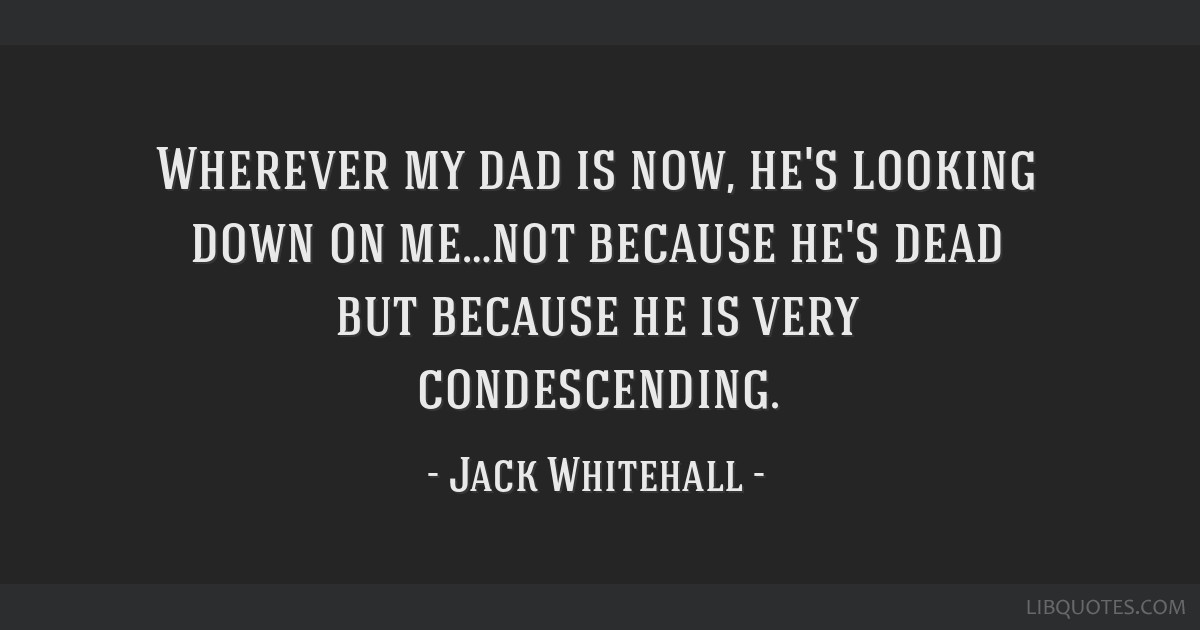
Jack Whitehall’s joke about his father—“I’m sure wherever my dad is, he’s looking down on us. He’s not dead, just very…”—is more than a punchline. It’s a cultural microcosm. On the surface, it’s classic British dry humor: understated, self-deprecating, and sharply timed. But beneath the laughter lies a layered commentary on honesty, work dynamics, and the awkward truths we navigate in family and professional life.
This single line, often shared as a “quote of the day,” doesn’t just entertain. It dissects the performance of modern relationships—how we mask discomfort with comedy, how hierarchy persists even in intimacy, and how truth is often delivered best through irony.
Let’s unpack why this joke resonates far beyond the stand-up circuit.
The Anatomy of a Perfect Comedic Truth
Comedy, at its best, reveals what polite conversation hides. Whitehall’s quote works because it subverts an expected sentiment. When someone says, “He’s looking down on us,” the assumption is grief, reverence, loss. Whitehall flips it: the father is alive, judgmental, and emotionally distant—so much so that his presence feels spectral.
“He’s not dead, just very…” The pause says everything. It doesn’t need completion.
This is a masterclass in comedic timing and emotional honesty. The unspoken words—disappointed, detached, busy being a traditional British dad—are implied. And in that gap between what’s said and what’s understood, we find universal recognition.
Real-World Parallel: Think of workplace feedback. How often do managers say, “Great job,” with a tone that communicates the opposite? Whitehall’s joke mirrors that dissonance—saying one thing, meaning another, and everyone knowing it.
Honesty in Relationships: Why We Hide Truth in Jokes
Whitehall’s relationship with his father, famously explored in Travels with My Father, thrives on this dynamic. The Netflix series documents their strained bond, cultural expectations, and generational silence. What emerges isn’t just comedy—it’s catharsis.
The quote reflects a deeper truth: many of us use humor to broach painful subjects. We say the hard things indirectly, wrapped in irony, because directness feels too dangerous.
Common Mistakes in Emotional Communication: - Avoiding confrontation by joking - Assuming the other person “gets it” without clarification - Mistaking sarcasm for honesty
Whitehall’s joke succeeds because it is honest—even as it’s disguised as absurdity. It admits: My dad is emotionally unavailable. We both know it. And it’s kind of ridiculous.
In personal and professional settings, this kind of coded honesty is widespread. A colleague says, “I love how spontaneous your deadlines are,” when they mean “You’re constantly late.” The joke relieves tension but rarely resolves the issue.
Workplace Tip: When humor keeps circling the same topic, it’s a red flag. If your team keeps making jokes about a manager’s micromanaging, address the behavior—not the punchline.
Work Culture and the British "Stiff Upper Lip"
Whitehall’s humor is deeply rooted in British cultural norms—particularly the suppression of emotion in favor of decorum. His father, Michael Whitehall, is the archetype: posh, polished, emotionally reserved. The joke lands because it critiques a real cultural pattern.
In many traditional work environments, especially in the UK, emotional restraint is mistaken for professionalism. Openness is seen as weakness. Conflict is avoided at all costs. Decisions are made behind closed doors, and feedback is delivered with layers of politeness.
This creates a work culture where: - Employees don’t feel psychologically safe - Innovation is stifled by hierarchy - Misunderstandings fester under polite smiles
Whitehall’s quote, while about family, exposes the same mechanism. The father “looks down” not from heaven, but from a position of emotional elevation—detached, observing, judging, but never engaging.
Use Case Example: A junior employee notices a flaw in a senior leader’s strategy. Instead of speaking up, they joke: “Wow, I guess we’re going full Lord of the Flies with this project.” The team laughs, but no action is taken. The joke was a cry for help in costume.
The lesson? Create environments where truth doesn’t need a disguise.
Human Nature: Our Love for Misdirection
Why do we laugh at Whitehall’s quote? Because it mirrors how we navigate truth in everyday life.
We: - Use euphemisms (“He’s resting” instead of “He’s dead”) - Deploy irony to soften blows (“Nice job… almost”) - Rely on implication rather than clarity
This isn’t dishonesty—it’s social survival. But over time, these habits erode trust. If everything is half-said, how do we know what’s real?
Whitehall’s comedy forces us to confront that. By taking a cliché (“looking down on us”) and twisting it into something painfully real, he highlights the absurdity of our emotional evasions.
Psychological Insight: Studies in social psychology show that humor is often used as a defense mechanism—especially in high-pressure or emotionally distant relationships. Whitehall’s material doesn’t just exploit this; it exposes it.
In families, this plays out as generations of unspoken expectations. In offices, it becomes passive-aggressive Slack messages and “casual” feedback that isn’t casual at all.
Workplace Workflow Tip: Replace indirect humor with structured feedback channels. Implement regular 1:1s with clear agendas. Normalize saying, “I found that comment confusing—can we clarify?” without fear of seeming “difficult.”
The Power of Vulnerability in Leadership
One of the most underrated lessons from Whitehall’s joke is its implicit call for vulnerability.
By publicly lampooning his father’s emotional distance, Jack does something radical: he names the unspoken. And in doing so, he models what healthy relationships—personal or professional—require.
Great leaders aren’t those who “look down” from authority. They’re the ones who step beside you, admit uncertainty, and say, “I don’t have this figured out either.”
Realistic Leadership Shift: - From: “Everything’s fine” (while clearly stressed) - To: “I’m overwhelmed—can we reprioritize?”
This isn’t weakness. It’s trust-building.
Whitehall’s comedy, especially in Travels with My Father, shows transformation. The reserved father slowly opens up—not because he’s told to, but because his son keeps showing up, keep joking, and keeps loving.
That persistence is the blueprint for cultural change in any group.
Example in Teams: A manager shares a past failure during onboarding: “I once launched a campaign with a typo in the headline. We fixed it fast, but I learned to triple-check everything.” This small act normalizes imperfection—and makes it safe for others to do the same.
Why This Quote Stays Relevant
“Quote of the day” content often fades fast. But Whitehall’s line endures because it’s not just funny—it’s diagnostic.
It reveals: - How we avoid emotional labor - How hierarchy masquerades as care - How comedy can be the most honest form of communication
And it does so without lecturing. It doesn’t say, “British parenting is flawed” or “Workplaces need more transparency.” It just says, “My dad’s alive, but he might as well be dead—and isn’t that kind of hilarious?”
That’s the power of sharp, human-centered storytelling.
Applying Whitehall’s Wisdom: 3 Practical Steps
You don’t need to be a comedian to use this insight. Here’s how to apply it:
- Interpret the Joke as a Signal
- When someone jokes about a recurring issue—lateness, disengagement, stress—listen deeper. The humor is a flag.
- Replace Indirectness with Curiosity
- Instead of laughing off a barb, ask: “What’s behind that joke? I want to understand.”
- Normalize Imperfect Communication
- Share your own struggles openly. Say, “I’m not great at this, but I’m trying.” It gives others permission to do the same.
These aren’t dramatic overhauls. They’re small shifts that erode the “looking down” culture—whether in families or offices.
This quote isn’t just a laugh. It’s a mirror. It shows us how we hide, how we judge, and how we sometimes love from a distance—emotionally, physically, professionally.
Jack Whitehall’s genius is making us laugh at the very behavior we’re guilty of. And in that laughter, there’s space to change.
Start today: Say what you mean. Ask what you’re afraid to ask. And if you need to, wrap it in a joke—then explain it after.
FAQ
What is Jack Whitehall’s most famous quote? While he has many memorable lines, “I’m sure wherever my dad is, he’s looking down on us. He’s not dead, just very…” stands out for its blend of humor, familial tension, and emotional truth.
Is Jack Whitehall’s dad actually alive? Yes, Michael Whitehall is alive. The joke plays on the emotional distance between them, not literal death.
What show features Jack Whitehall and his dad traveling together? Travels with My Father, a Netflix series, documents their global trips and evolving relationship.
How does Jack Whitehall use comedy to address serious topics? He uses irony and exaggeration to expose emotional repression, generational gaps, and the absurdity of social norms—especially in British culture.
What can we learn about work culture from this quote? It highlights how hierarchy and emotional distance can persist in professional settings, often masked by politeness or humor. True connection requires vulnerability.
Why is this quote shared as “quote of the day” content? Because it’s concise, humorous, and layered—it entertains, but also invites reflection on family, honesty, and human behavior.
How can leaders apply the lesson from this quote? By avoiding the “looking down” mindset, engaging peers and teams as equals, and fostering open, honest communication—even when it’s uncomfortable.
FAQ
What should you look for in Jack Whitehall’s Quote of the Day: A Lesson in Humor and Truth? Focus on relevance, practical value, and how well the solution matches real user intent.
Is Jack Whitehall’s Quote of the Day: A Lesson in Humor and Truth suitable for beginners? That depends on the workflow, but a clear step-by-step approach usually makes it easier to start.
How do you compare options around Jack Whitehall’s Quote of the Day: A Lesson in Humor and Truth? Compare features, trust signals, limitations, pricing, and ease of implementation.
What mistakes should you avoid? Avoid generic choices, weak validation, and decisions based only on marketing claims.
What is the next best step? Shortlist the most relevant options, validate them quickly, and refine from real-world results.